Abstract
Commuting Hamiltonians lie at the boundary between classical constraint satisfaction and quantum many-body physics, exhibiting rich quantum structure while remaining more tractable than general noncommuting models. In contrast, physical Hamiltonians are rarely exactly commuting, which motivates the study of \emph{almost commuting} Hamiltonians. Despite their relevance, the implications of approximate commutation are only poorly understood.
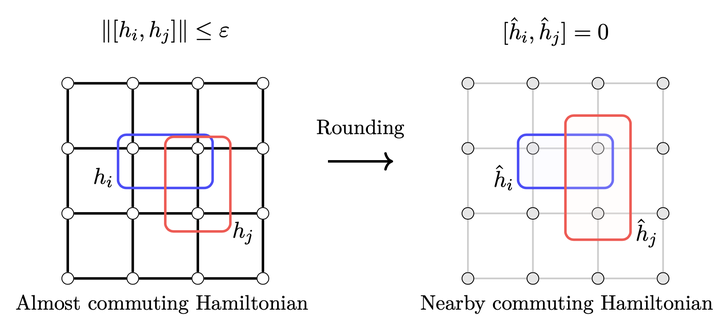
In this work, we show how to efficiently approximate any almost commuting $2$-local qubit Hamiltonian by a commuting one: we give a new locality-preserving \emph{algorithmic rounding technique} that maps any $2$-local Hamiltonian $H=\sum_{i=1}^m h_i$ with $|[h_i,h_j]| \leq \varepsilon$ to a nearby Hamiltonian $\hat{H}$ whose terms pair-wise commute, and which is within overall distance $|H-\hat{H}| = O(m,\varepsilon^{1/6})$.
As a consequence, we show that $\delta$-approximations to the ground energy for $\varepsilon$-almost commuting $2$-local qubit Hamiltonians lie in $\mathsf{NP}$ when $\delta \gg m\varepsilon^{1/6}$, extending the classical containment well beyond the commuting setting. Finally, we present two applications of our rounding framework: Gibbs sampling and fast Hamiltonian simulation for almost commuting systems.
Islam Faisal
PhD Candidate
My research interests include quantum computing, complexity theory, cryptography, security, and privacy.
Anand Natarajan
Associate Professor at MIT
I am an Associate Professor in EECS and CSAIL at MIT. Prior to starting as a faculty member, I was a postdoc at the Institute for Quantum Information and Matter at Caltech. I obtained my PhD in Physics in 2018 at MIT, under the supervision of Aram Harrow.
Alexander Poremba
Assistant Professor at Boston University
I am an Assistant Professor at Boston University, where I share a joint affiliation with the Department of Computer Science and the Department of Physics. Previously, I was a postdoctoral researcher at MIT hosted by both Vinod Vaikuntanathan and Peter Shor. I received my PhD in Computer Science from Caltech, where I was fortunate to have been advised by Thomas Vidick.